Testing platform for autonomous systems based on Physical AI
- Duration: September 2026 – August 2029
- Estonian title: Füüsilisel tehisintellektil põhinevate autonoomsete süsteemide testimisplatvorm
- Lead: Raivo Sell
- Maturity: TRL 4 → TRL 6
An independent safety layer for AI-driven machines
AI makes machines more capable. TemTA adds a Safety Guardian that keeps the machine inside safe limits. The same solution works on vehicles, humanoid robots and drones, in simulation and on the physical machine.
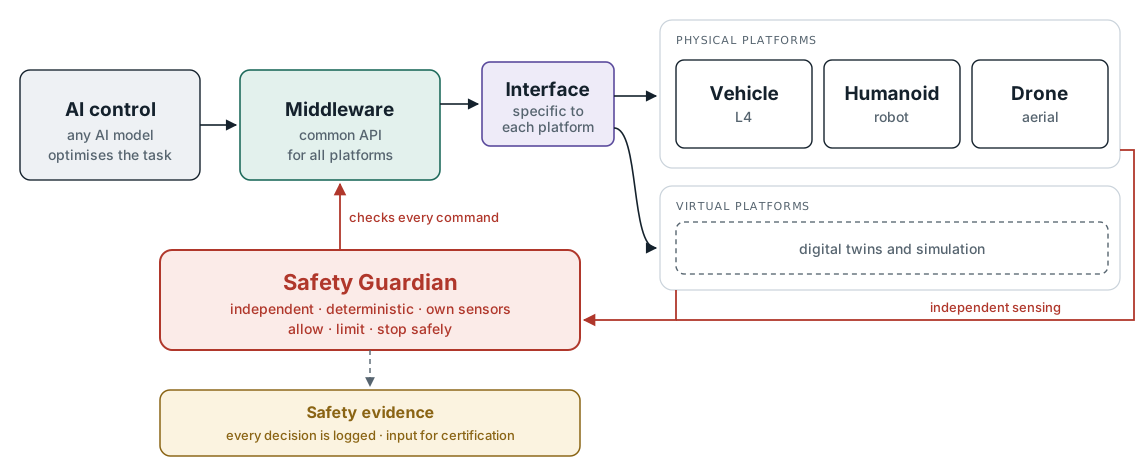
- Safety outside the AI. The AI optimises many goals. The Guardian watches only safety and does not depend on the AI.
- One solution, many machines. Vehicles, humanoids and drones share the same middleware. Each platform adds only its own interface.
- Simulation to physical. The same code runs in simulation, on a test bench and on the physical machine.
- Evidence for certification. Each Guardian decision is a traceable record for the safety case.
What the project builds
The project builds a modular sim-to-real testing platform with independent safety supervision. The platform serves self-driving vehicles, drones and humanoid robots. It supports end-to-end models and hybrid models.
The project has four main outputs:
- Middleware (integration layer). A platform-independent software layer with a documented API. It connects the AI control logic to the physical platform. It removes the need for platform-specific rework.
- Safety Guardian. An independent safety module. It monitors the AI control decisions in real time with its own sensors, for example LiDAR and radar. It intervenes when the main model leaves the allowed envelope. The design is platform-independent, so it transfers between systems.
- Physical low-level interface module. A hardware unit on the autonomous platform. It passes the control commands from the high-level software to the actuators.
- Validation methodology. A scenario-based method to validate the safety of end-to-end AI control models.
The platform is validated on at least two different platform types before the end of the project.
Research questions
The project answers three research questions:
- RQ1. What are the minimum architectural requirements for a standardised middleware that transfers end-to-end and hybrid AI control decisions safely to different physical platforms, without platform-specific rework?
- RQ2. Which validation methods and safety-architecture elements make the behaviour of a data-driven AI control model on a real vehicle predictable, traceable and compliant with scenario-based safety standards?
- RQ3. Which hardware architecture fits AI-intensive control algorithms on autonomous systems, and where are the critical limits for safety and latency?
Partners include Meridein Grupp, Teede Tehnokeskus, ScaleDrive, ITS Estonia, and Tallinn Industrial Education Centre (Techno TLN).