
Turning public vehicles into moving data collectors
- Duration: June 2025 – May 2028
- Pilot cities: Tallinn (Estonia), Dublin (Ireland), Pula (Croatia)
- Total budget: €1.2M (TalTech budget)
- Project website
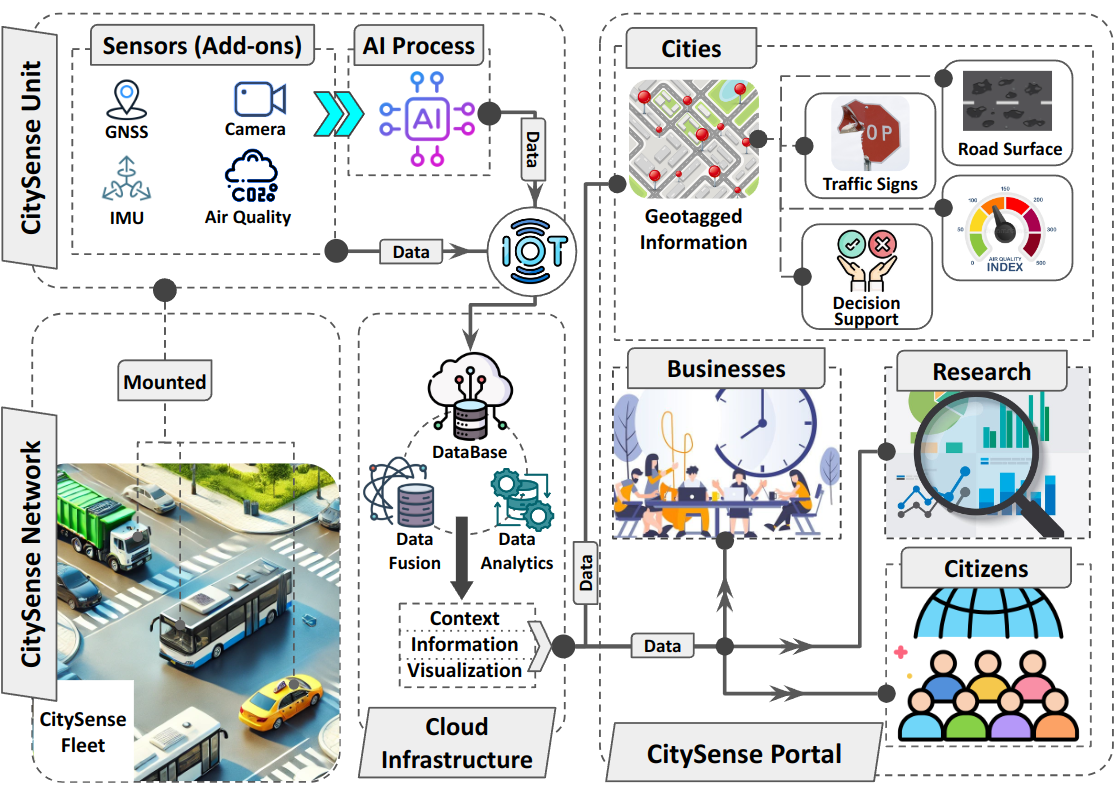
TayuTech develops a mobile, modular urban sensing and analytics platform by equipping existing public or partner vehicles, such as buses, taxis, and waste trucks, with compact sensor units. Instead of relying only on costly fixed sensing infrastructure, the project turns vehicles that already move through the city into roaming data-collection nodes for real-time urban monitoring.
The project addresses key smart-city challenges, including fragmented urban sensor data, limited geographic coverage, and the need to turn raw measurements into actionable insights for city authorities. Modular sensor units can include cameras, air quality monitors, and other environmental sensors. Onboard AI processes data locally before relevant insights are transmitted to a secure cloud environment and made available through the TayuTech Portal.
Our role
As the TayuTech cloud team, our research group provides the digital backbone that connects mobile sensing units and modules to a reliable, scalable, and secure cloud platform. This includes designing and maintaining the data ingestion pipeline, storing multimodal sensor data in structured databases, linking detections with images and metadata, supporting API-based integration, and building dashboards and visualization tools such as the TayuTech Portal.
In practice, our role is to ensure that data collected in the field becomes accessible, trusted, and useful for cities, researchers, and project partners. The cloud platform enables near-real-time monitoring, analytics, reporting, and future expansion of the TayuTech ecosystem.
Pilot use cases
- Tallinn: detection of damaged or missing traffic signs to improve traffic safety and support autonomous mobility.
- Dublin: monitoring air quality and allergen levels for public health and urban environmental planning.
- Pula: mapping and identifying road surface defects to support predictive maintenance and improve ride comfort.
Expected impact
TayuTech demonstrates how cities can collect higher-quality urban data using flexible sensor modules and AI-enabled edge processing. The results are expected to support improved road safety, healthier urban environments, predictive infrastructure maintenance, and future smart mobility services.
The implementation of the pilot project is funded by the European Regional Development Fund and the Estonian Ministry of Education and Research through the FinEst Centre for Smart Cities pilot programme.